
CrossRoads Paving Solutions
Black Americans in Construction: Paul Revere Williams
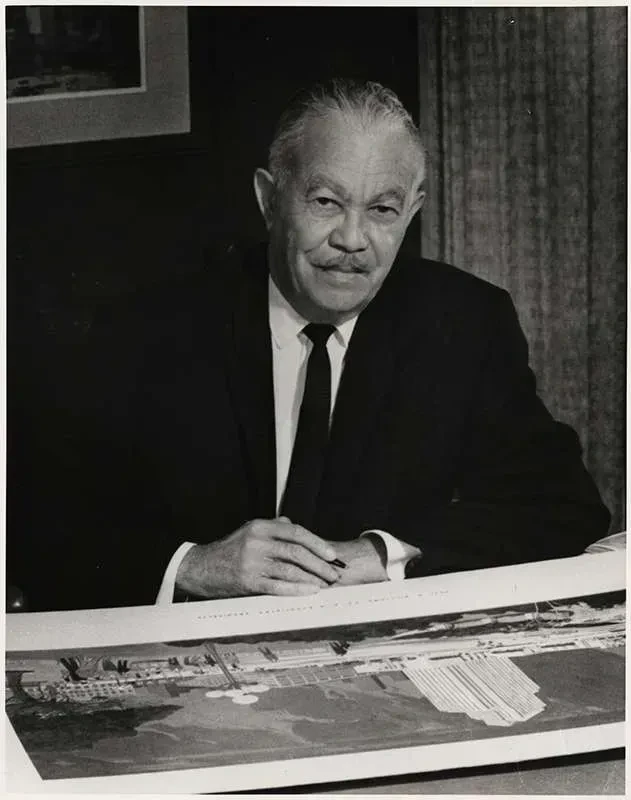
Born February 18, 1894 in Los Angeles, California, Paul Revere Williams was an African American architect. Throughout his career, Williams faced numerous professional challenges due to his race. He developed unique workarounds, such as learning to draw upside down, to accommodate the prejudices of some white clients, and avoided expecting handshakes at construction sites to navigate racial barriers. Despite these indignities, Williams's legacy is significant, especially in Los Angeles, where his work is a prominent part of the city's architectural landscape.
Williams's career spanned nearly six decades, during which he completed over 3,000 projects. He was renowned for his mastery of the Late Moderne architectural style, characterized by long horizontal lines and sleek curving forms. His portfolio includes a diverse range of projects, from residential homes for celebrities like Lucille Ball, Frank Sinatra, and Cary Grant, to commercial and public buildings that have become modernist fixtures in Los Angeles. Notable projects include the MCA headquarters, the Ambassador Hotel renovation, the Los Angeles International Airport (LAX), and the First African Methodist Episcopal Church, among others.
His contributions extended beyond Southern California, with significant projects in Colombia and involvement in international endeavors like the U.N. Building in Paris. Williams's impact was profound in the African American community, notably through his work with the Golden State Mutual Life Insurance Company and the First AME Church, reflecting a deep commitment to social progress and community building.
Williams retired in 1973, leaving behind a legacy honored by numerous awards, including the AIA's Award of Merit and the NAACP's Spingarn Medal. He was posthumously awarded USC Architecture's Distinguished Alumni Award in 2017. His passing in 1980 marked the end of an illustrious career, but his influence endures.
The Getty Research Institute and the USC School of Architecture now co-own Williams's archive, committing to preserve and extend his legacy through research, exhibitions, and programming. The archive, which will be housed at Getty, includes a significant digitization effort to make the materials accessible to scholars and the public, highlighting Williams's contributions to architecture and the cultural legacy of African American artists.
Ready to transform your outdoor space?
Contact CrossRoads Paving Solutions for a free estimate.
Get A Free Quote